
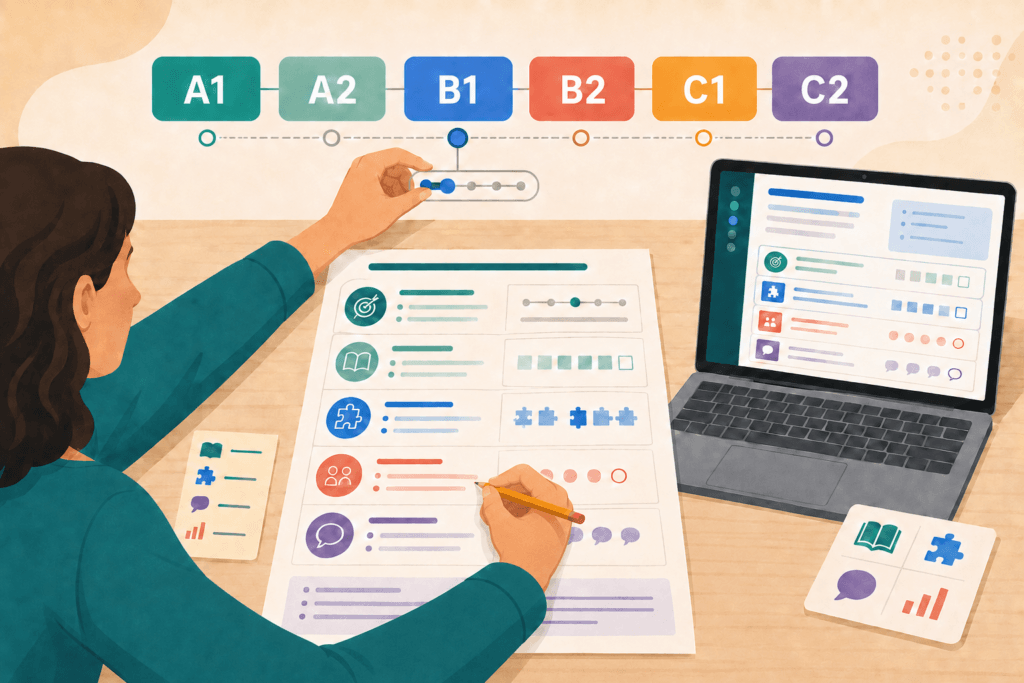
Asking AI to “create an A2 lesson” is a starting point, not a complete teaching brief.
A lesson can contain short sentences and familiar vocabulary yet still ask students to do something they are not ready for. The reading may be manageable, but the instructions, listening speed, or final speaking task may be too demanding.
To create a useful CEFR-aligned lesson, begin with what students should be able to do. Then use AI to draft the plan, develop materials, and adjust support.
The level label helps guide the process. It does not replace teacher judgment.
What Does CEFR-Aligned Mean?
The CEFR describes language proficiency through “can-do” descriptors, rather than simply listing grammar structures for each level. These descriptors cover different language activities, including reception, production, interaction, and mediation. See the Council of Europe’s CEFR level descriptions.
For lesson planning, this means connecting three things:
- Objective: What will students communicate or understand?
- Practice: What activities will prepare them?
- Evidence: What will show that they can do it?
“Practice food vocabulary” identifies content. “Order a drink and snack and respond to a simple follow-up question” describes a communicative outcome.
Both vocabulary and grammar matter, but they should support that outcome.
Step 1: Choose One Clear Communicative Goal
Select a relevant descriptor from the official CEFR descriptor search, then turn it into a manageable classroom objective.
For example, A2 includes simple, routine exchanges of information in familiar situations. A café role-play is one possible classroom application — not an official assessment of a student’s overall level. (CEFR global scale)
A practical objective might be:
By the end of the lesson, students can order a drink and snack, answer a simple follow-up question, and ask for repetition when needed.
Decide what success will look like before generating the worksheet. In this lesson, success means completing the exchange, not memorizing a dialogue or filling every gap correctly.
Step 2: Describe the Learners and Teaching Conditions
Give the AI more information than “A2.” Include:
- Learner age and relevant experience
- Language students already know
- The skill you want to develop
- Available time and equipment
- Support students may need
- The final task
For example:
Age and language proficiency are separate considerations. An adult beginner may need simple English without childish topics or activities.
Also consider differences across skills. A student who reads an A2 dialogue comfortably may need more support understanding the same exchange aloud.
Step 3: Generate the Lesson Structure
For a structured first draft, use MagicSchool’s Lesson Plan Generator. Supply the objective, learner context, time available, and differentiation needs.
If a tool emphasizes school grades, include the students’ actual age and English proficiency in the additional instructions. Do not substitute a primary-school grade for an adult’s language level.
Ask for clear stages rather than a long list of possible activities. A useful planning prompt is:
A plan and a set of materials are different outputs. Check whether the draft actually includes the menu, dialogue, activity, and teacher notes it refers to.
Step 4: Create Only the Materials You Need
Once the sequence makes sense, generate the supporting materials.
A Model Conversation
Use Twee’s Create a Dialogue on Any Topic. Choose the café situation, select A2, and include target expressions such as:
- I’d like…
- Anything else?
- For here or to go?
- Could you say that again, please?
Review the exchange for naturalness and relevance. Keep it short enough for students to hear more than once.
A written script is not an audio recording. Arrange a clear spoken model through a teacher demonstration or a reviewed recording.
Supported Practice
Use Twee’s Fill in the Gap with the reviewed dialogue. Remove only the expressions you want students to practice.
This gives students a bridge between hearing the model and completing their own exchange. It should not become the entire lesson.
Adjusting Existing Material
If you already have a suitable text, use Simplify or Upgrade Your Text to request an adaptation at the target CEFR level.
Compare the result with the original. Simplification should preserve the meaning and purpose of the exchange, not merely replace words or shorten every sentence.
You do not need to use every tool. If your existing materials already fit the objective, keep them.
Step 5: Check More Than the CEFR Label
Before teaching, review the whole task — not just its vocabulary.
| Check | Questions to ask |
|---|---|
| Language | Are unfamiliar words and structures necessary and supported? |
| Instructions | Can students understand what to do without a lengthy explanation? |
| Listening | Are the speed, clarity, length, and opportunities to replay appropriate? |
| Response | Must students recognize information, recall language, or create an original answer? |
| Background knowledge | Does the task assume unfamiliar cultural or practical knowledge? |
| Support | Are menus, examples, pictures, or sentence starters available where needed? |
The same dialogue can support very different tasks. Matching a customer to an order is not the same demand as improvising a conversation with an unexpected problem.
AI-generated level labels — and automated level checks — should be treated as additional information, not proof that a lesson is appropriately aligned.
Step 6: Keep One Goal, With Different Support
Mixed-level teaching does not always require separate lessons. For the café task:
- Learners needing more support receive a picture menu, a phrase bank, and time to rehearse.
- Other learners receive the menu and role cards without a complete script.
- Learners ready for an extension can handle an unavailable item and choose an alternative.
Everyone still works toward the shared goal of completing an order.
Avoid assigning permanent “low” and “high” identities. Adjust support according to the task and what you observe.
For a broader introduction to learner profiles, see ESL Levels: The Complete Guide for Teachers.
Example: A 45-Minute A2 Café Lesson
The following is an illustrative plan. Adjust the timings for your class.
| Stage | Time | Student activity |
|---|---|---|
| Prepare | 5 minutes | Look at a menu and recall familiar words |
| Hear the model | 8 minutes | Listen for the order, then listen again for follow-up questions |
| Notice useful language | 7 minutes | Identify requesting, responding, and repetition phrases |
| Supported practice | 10 minutes | Complete selected gaps and rehearse with a partner |
| Communicate | 10 minutes | Change partners and order using different choices |
| Check and reflect | 5 minutes | Complete a brief final exchange and identify remaining difficulties |
For the final task, check whether students can:
- Make an understandable order
- Respond to a relevant follow-up question
- Use a repetition request if needed
- Complete the exchange without reading a full script
These are lesson-specific success criteria. Completing this activity alone does not establish an overall A2 level.
After Class: Use the Evidence to Revise
Note where communication broke down.
Did students recognize “For here or to go?” when reading but miss it in speech? Could they order confidently but struggle with prices? Did the phrase bank help, or did students rely on it throughout?
Use those observations to request a focused revision:
This is more useful than asking AI to “make the lesson easier.” It identifies the difficulty you actually observed.
Final Thoughts
A CEFR-aligned lesson starts with a communicative goal and ends with evidence of what students can do.
Use AI to draft the sequence and prepare supporting materials. Then check the language, task demands, classroom conditions, and amount of support.
For current plans and feature access, visit the official MagicSchool pricing page and Twee pricing page.
The strongest lesson is not the one with the most convincing level label. It is the one whose objective, practice, and final task fit the learners in front of you.