
Choosing an English coursebook is a decision you may live with for an entire school year.
A familiar title is a useful starting point. But before buying a class set, you need to know whether its lessons fit your students, teaching time, and available resources.
Start With Your Teaching Situation
Before comparing titles, identify:
- Your learners: age, interests, English proficiency, and literacy experience.
- Your purpose: general communication, school learning, exam preparation, or a combination.
- Your conditions: class size, teaching hours, equipment, and access to materials.
- Your support needs: audio, lesson guidance, answer keys, assessment, and additional practice.
A book’s level number is not a universal standard. “Level 3” in one series does not necessarily match “Level 3” in another.
For help assessing your learners before choosing materials, see our complete guide to ESL levels.
The Shortlist at a Glance
The distinctions below are starting points for comparison, not exclusive strengths.
| Learners | Series | Publisher | Consider it when you want… |
|---|---|---|---|
| Children | Let’s Go | Oxford University Press | Spoken models, songs, and structured language practice |
| Children | Big English | Pearson | English learning connected with subject content |
| Teens | Impact | National Geographic Learning | Real-world topics and project-based communication |
| Teens | Time Zones | National Geographic Learning | An American English course covering beginner to pre-intermediate learning |
| Adults and young adults | Interchange | Cambridge University Press & Assessment | A communicative American English course |
| Adults and young adults | English File | Oxford University Press | Integrated language work with pronunciation and video |
| Adults and young adults | Empower | Cambridge University Press & Assessment | General English with integrated assessment and digital practice |
Check the exact edition and package available in your country. Student books, workbooks, teacher materials, and digital access may be sold separately.
English Coursebooks for Children
1. Let’s Go — Oxford University Press
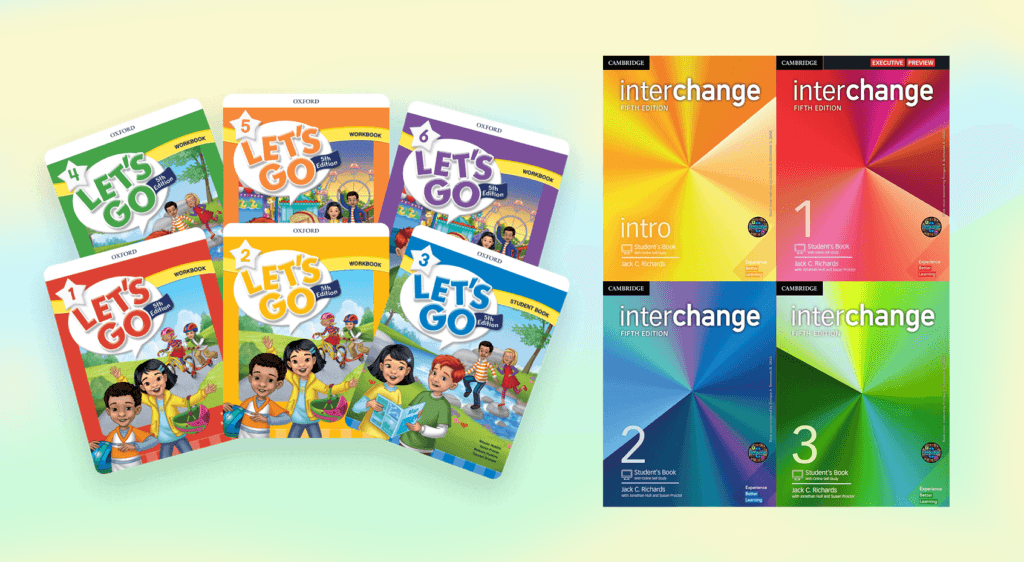
Let’s Go is worth considering when you want recorded language models and a familiar structure for young learner practice.
Oxford’s fifth-edition audio materials include songs, conversations, and chants. Its teacher resource site also provides teaching support, including fifth-edition how-to guides. Check the fifth-edition course information and the components available locally.
How you might use it: Play a conversation, check meaning with pictures or actions, and rehearse a useful exchange. Then change the information so children ask and answer for themselves.
For example, after practising a model question, give partners different picture cards. They must listen to discover what their partner has.
What to check: Can children understand and use the language beyond the recording? Successful repetition does not automatically mean independent communication. Also check that the reading and writing demands suit their literacy development.
Make sure the audio and teacher materials match the edition you purchase.
2. Big English — Pearson
Big English is a useful comparison candidate when you want to connect English with subjects and ideas beyond everyday conversation.
Pearson describes the series as using CLIL—Content and Language Integrated Learning—alongside integrated skills work. It offers Big English and Big English Plus, with British and American English options. See the official course overview.
How you might use it: Build a language task around a simple science or social-studies topic. Students might classify animals, compare habitats, or explain a familiar process using pictures and sentence starters.
Keep the language goal clear. Naming facts and explaining a comparison require different support.
What to check: Subject content can create additional demands. Before assigning a text, check whether students understand the underlying concept as well as the English.
Compare Big English and Big English Plus rather than treating them as identical packages.
For either children’s series, use our ESL levels guide for children to separate spoken English needs from reading and writing readiness.
English Coursebooks for Teens
3. Impact — National Geographic Learning
Impact is a candidate for classes that use real-world topics to encourage discussion, explanation, and project work.
The second edition incorporates National Geographic content, and the publisher illustrates opportunities for open-ended projects and activities — see these classroom examples. For course information and components, see the Impact second-edition overview.
How you might use it: Begin with an image or short video, establish the key information, and give students a question with more than one possible answer. Move from preparation to pair discussion and a short recommendation or explanation.
What to check: An interesting topic is not automatically accessible. Review background knowledge, vocabulary, audio demands, and the amount of support needed for discussion.
Ask students about their interests instead of assuming that all teenagers respond to the same global issues. Check digital access arrangements for your chosen package.
4. Time Zones — National Geographic Learning
Time Zones is worth considering when you want an American English course for teenagers beginning English or building toward pre-intermediate proficiency.
The third edition is a five-level series that the publisher describes as covering true beginner to pre-intermediate for secondary and teen learners in American English. It uses photography, video, and stories about global citizens. See the official Time Zones overview.
How you might use it: Introduce a topic through a photograph, play a short course recording, and check the main meaning. Rehearse useful expressions before asking students to exchange information or make a choice with a partner.
For example, after practising a model conversation, give partners different details so they must listen and respond rather than repeat the same script. This is a suggested teaching approach, not a description of a specific unit.
What to check: Preview the selected level’s reading load, audio, and task instructions. A beginner label does not guarantee suitability for every learner, particularly students needing additional literacy support.
Confirm which teacher resources and Spark access are included in the package you purchase. Do not assume that student and teacher access are interchangeable.
For placement considerations, see our ESL levels guide for teens.
English Coursebooks for Adults and Young Adults
5. Interchange — Cambridge University Press & Assessment
Interchange is a strong candidate for teachers seeking a communicative American English course.
Cambridge describes it as a four-level series used by more than 50 million students worldwide. That is a publisher-reported usage figure, not an independently verified sales ranking. Its fifth-edition materials emphasize communication and regular speaking practice. See the official teacher’s edition information.
How you might use it: Start from a model exchange, practise the useful language, and ask students to personalize the situation. Follow a controlled dialogue with a task requiring a real choice or missing information.
What to check: Look beyond whether students can complete the grammar exercise. Can they understand the spoken model and respond without reading?
A general English course may also need supplementary work for a specific professional, academic, or literacy goal.
6. English File — Oxford University Press
English File is worth considering when you want grammar, vocabulary, pronunciation, and skills work connected within a general English course.
Oxford’s fifth-edition description highlights video supporting these areas. See the official fifth-edition overview.
How you might use it: Connect a pronunciation focus to a practical speaking task. After listening and rehearsing, ask students to use the language in a new exchange, then give feedback on intelligibility and meaning.
Video can also provide context: students can identify the situation and purpose before examining particular expressions.
What to check: Preview the listening and reading load, not just the grammar syllabus. Learners may recognize a structure on paper but struggle to follow it in speech.
English File and American English File are distinct versions. Check the title, edition, audio, and teacher package carefully rather than mixing components.
7. Empower — Cambridge University Press & Assessment
Empower is a candidate when you want general English with assessment and digital practice integrated into the course package.
For example, Cambridge’s second-edition A2 Digital Pack includes online assessment, a digital workbook, and an eBook. The precise components depend on the product purchased. See the official package description.
How you might use it: Teach a unit, combine assessment results with classroom observations, and select follow-up practice for an identified need.
If students understand the target language but struggle to use it in conversation, add interaction rather than simply assigning more of the same written exercise.
What to check: Confirm that learners have suitable devices, connectivity, and access codes. Decide how you will support students who cannot complete online work.
Use assessment information alongside independent performance in class, not as the only evidence of progress.
For adult-specific planning, see our ESL levels guide for adults.
Before Buying: Try One Unit, Including the Audio
Do not choose from the cover and contents page alone. Request a sample unit, matching audio, and teacher guidance.
Work through five questions:
- Can students access the lesson? Check language, topic knowledge, reading demands, and instructions.
- What will they hear? Preview the recordings and decide where repetition or other support is needed.
- What will they communicate? Look for a purpose beyond filling blanks or repeating sentences.
- Can you teach it in your conditions? Consider lesson length, class size, equipment, and preparation.
- What does the purchase include? Confirm workbooks, answer keys, teacher access, digital licenses, and any expiry conditions.
For non-native English teachers, usable recordings and clear teacher guidance are especially worth inspecting. Ask whether you can play, pause, replay, and locate the material easily during a lesson.
If reliable internet is unavailable, confirm that the required resources can be used offline under the publisher’s access terms.
Prices and packages vary by market, so use official publisher pages or authorized local suppliers for current purchasing information.
Where AI Can Help—and Where It Should Not Take Over
Once you choose a coursebook, AI can help you draft a supplementary role-play, a different example, or additional practice around the learning goal.
Describe the target language and task rather than uploading entire chapters. Follow the publisher’s permissions and your school’s policies when using copyrighted content.
Review every supplement for accuracy, level, and consistency with the lesson. A generated worksheet is useful only if it addresses a real need.
For ways to bridge the gap between a book and your learners, see What Real Classrooms Need vs. What Coursebooks Assume.
Final Thoughts
A recognizable coursebook gives you a starting point—not a guarantee of a suitable course.
Shortlist two series for your learners, compare the same level, and teach or carefully work through a sample lesson before committing.
The useful question is not simply “Which book is most popular?” It is “Which book gives these learners a workable path from understanding the model to using English themselves?”