
Mixed-level ESL classes are difficult because students may be studying the same topic while reading at very different levels. One learner may understand the main text independently, while another needs shorter sentences, vocabulary support, or a graphic organizer.
Creating separate materials for every group is rarely practical. This is where Diffit can help. It allows teachers to adapt a shared text and add scaffolds without creating an entirely separate lesson for each level.
The goal, however, should not be to give students three unrelated lessons.
What Is Diffit?
Diffit is an AI-powered tool for creating and adapting classroom materials. Teachers can begin with:
- A topic or prompt
- Pasted text
- A webpage
- A PDF
- A video transcript
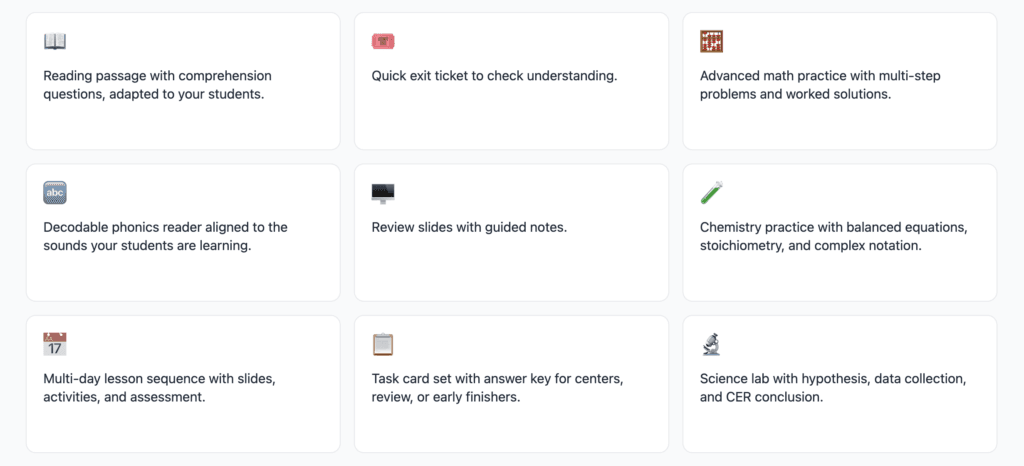
Depending on the selected options, Diffit can produce an adapted reading, vocabulary support, comprehension questions, activities, and graphic organizers.
Diffit now offers more than basic text simplification, but its strongest use for mixed-level ESL classes is still clear: helping students access the same core content with different levels of language support.
A basic free version is available. Some advanced customization, alignment, organizer, and export features require an individual or school subscription. Check the current Diffit pricing page before deciding which plan you need.
Why Diffit Works for Mixed-Level ESL Classes
Mixed-level teaching does not always require completely different materials. In many cases, students can study the same content if the teacher adjusts the language load and the amount of support.
For example, every student might study climate change and answer the same final question:
What is one cause of climate change, and what is one possible solution?
The support can vary:
- Beginning learners receive a shorter text, key vocabulary, and sentence frames.
- Intermediate learners receive a longer text and guided comprehension questions.
- More advanced learners read a less-adapted version and respond to an open-ended question.
The topic and final objective remain the same. Only the pathway changes.
This approach makes it easier to bring the class together for pair work, group discussion, or a shared writing task.
How to Use Diffit for a Mixed-Level ESL Lesson
Step 1: Begin With One Shared Objective
Before opening Diffit, decide what every student should understand or be able to do by the end of the lesson. A useful objective might be:
- Identify the main idea and two supporting details.
- Explain one problem and suggest a solution.
- Compare two people, places, or ideas.
- Give an opinion and support it with evidence from the text.
Avoid starting by asking, “How many versions should I make?” Start with the common learning goal instead.
Step 2: Choose Your Source Material
You can paste an existing text, upload a document, enter a URL, use a video transcript, or ask Diffit to create material about a topic.
For ESL classes, shorter source materials are usually easier to review and adapt. If you use a webpage or AI-generated passage, check:
- Factual accuracy
- Cultural appropriateness
- Unnecessarily difficult background knowledge
- Vocabulary that students actually need
- Copyright or classroom-use restrictions
Do not include student names, personal information, or confidential school data in a prompt or uploaded document.
Step 3: Create the First Version
Select a reading level that suits one group in your class and generate the resource. Review that version before creating or adjusting materials for the other groups.
Diffit primarily adjusts materials by reading level. A reading level is not the same as a student’s complete CEFR proficiency.
A learner may read successfully at one level but have different speaking, listening, grammar, or writing abilities. Grade-level settings should therefore be treated as starting points — not as exact equivalents of A1, A2, B1, or B2.
Step 4: Adjust the Support for Each Group
Instead of lowering every part of the task, decide what each group actually needs. You might change:
- Text length
- Sentence complexity
- Number of new words
- Vocabulary definitions
- Question format
- Graphic organizers
- Sentence frames
- Amount of teacher guidance
For beginning learners, you could add:
For intermediate learners:
Advanced learners may answer the same question without a sentence frame and support their response with evidence from the text.
Step 5: Review Every Version
AI-generated materials should not go directly from the tool to the students. Check that:
- The central facts remain consistent across versions.
- Simplification has not changed the meaning.
- The questions can be answered from the passage.
- Vocabulary definitions fit the context.
- The easier version is clear without sounding childish.
- The advanced version is meaningfully challenging.
- Every group can complete the shared final task.
Diffit can reduce preparation work, but the teacher still decides whether the resource is appropriate.
Step 6: Distribute Materials Discreetly
Avoid publicly identifying students as “low,” “middle,” or “high.”
Printing each level on a different color of paper may be convenient, but it can make students’ assigned levels obvious. This is especially uncomfortable for teens and adults.
Use neutral labels such as:
- Version A, B, and C
- Text 1, 2, and 3
- Group Oak, Maple, and Pine
You can also distribute the materials individually or assign digital versions privately.
Step 7: Bring the Groups Back Together
Differentiation works best when students are not separated for the entire lesson. After students read their assigned versions, bring them together for a shared activity:
- Compare answers with a partner.
- Complete one group organizer.
- Discuss the same central question.
- Prepare a short group presentation.
- Write a shared summary.
- Complete an exit ticket.
Students do not need identical texts to participate in the same meaningful discussion.
Three Practical Classroom Examples
1. One News Story, Several Reading Levels
Choose one age-appropriate news article and adapt it for two or three groups. All students identify:
- What happened
- Who was involved
- Why it matters
The passages and vocabulary support differ, but the class discusses the same event together.
2. One Topic, Different Scaffolds
Suppose the lesson topic is job interviews.
Beginning learners receive a short passage, picture-supported vocabulary, and sentence frames. Intermediate learners read a longer passage and organize interview advice into “Do” and “Don’t” categories. Advanced learners evaluate the advice and add their own suggestions.
All groups finish by answering the same question:
What should a person do to prepare for a job interview?
3. A Video With Reading Support
If a video is too fast for some students, use its transcript to create an adapted reading.
Lower-level students can read the adapted passage and preview key vocabulary before watching. More advanced students can watch first and then use the passage to check details or compare the spoken and written versions.
An adapted transcript supports comprehension, but it does not replace listening practice. Students still need to hear the original audio and complete a listening-focused task if listening is part of the lesson objective.
Limitations Teachers Should Know
Diffit does not know your students as well as you do. A selected reading level cannot account for every learner’s age, background knowledge, confidence, or language profile.
It can also produce:
- Awkward simplifications
- Vocabulary that is too easy or too difficult
- Questions that focus only on factual recall
- Materials that look complete but do not match the lesson objective
Diffit can now create activities, instructional resources, and other classroom materials in addition to adapted readings. However, teachers should still check whether those tasks provide meaningful language practice rather than simply more worksheets.
For speaking or writing lessons, you may need to add interaction, modeling, feedback, and a clear communicative purpose yourself.
Final Thoughts
Diffit can be a valuable tool for mixed-level ESL classes when it helps students work with the same meaningful content.
Its best use is not creating three separate lessons. It is helping the teacher preserve one shared goal while adjusting the text, vocabulary, questions, and scaffolds students need to reach it.
Start small:
- Choose one short text.
- Create two versions.
- Add different supports.
- Keep one common final task.
- Review the results after class.
The most important question is not whether every student received the same worksheet. It is whether every student had a genuine way to participate in the same lesson.